India’s Mukesh Ambani: Bad boy billionaire or ‘a simple man’?
Advertising
People
India's Mukesh Ambani: Bad boy billionaire or 'a simple human being'?
With a fortune of United states$80 billion, Mukesh Ambani is 1 of Asia's richest individuals, and as divisive equally he is admired. On one paw, he is known to be aggressive and unscrupulous; on the other, a religious family homo who practises moderation. Volition the real Mukesh delight stand?
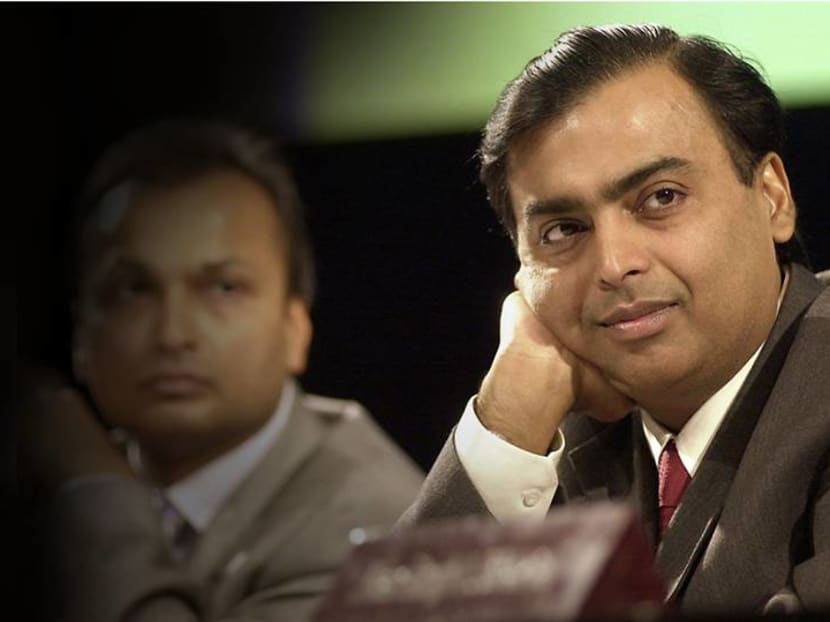
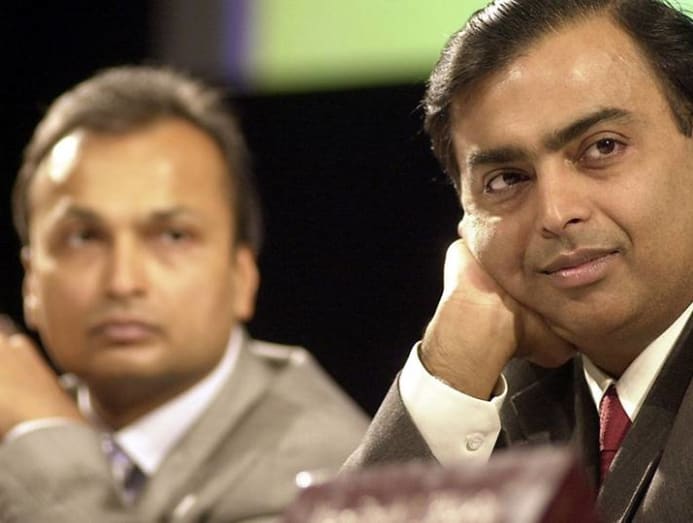
Mukesh Ambani and his brother Anil. (Photo: AFP)
When Ajit Mohan landed in the swampy heat of Mumbai concluding December, he was a man on a mission. The 45-year-old media executive had recently joined Facebook to help reboot its fortunes in India. Although the social media giant had more than than 300 one thousand thousand users in the land – more anywhere else in the earth – mis-steps and regulatory scuffles had scuppered its efforts to make any existent money there.
Mohan was joined by David Fischer, Facebook'due south chief revenue officeholder, and the pair were whisked out to the industrial suburb of Navi Mumbai. There, a series of meetings set up the visitor's plan in motion: To form an alliance with the richest homo in Asia.
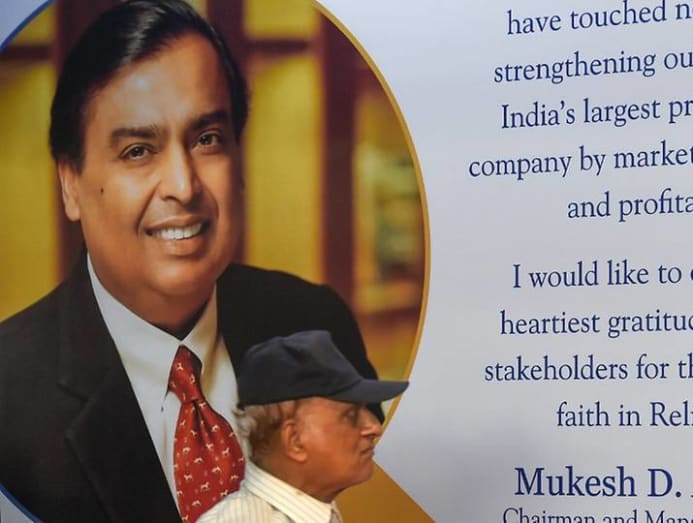
Mukesh Ambani would not be particularly recognisable outside of Bharat. Heavy set, with deep numberless under his eyes and a penchant for white brusk-sleeve shirts, the camera-shy 63-year-sometime is a sober contrast to hoodie-wearing, device-clutching American tech bosses. But that advent belies his importance in a country of 1.four billion people, and the power that his US$80 billion (Due south$108.half-dozen billion) fortune brings.
READ> Could Mukesh Ambani – Asia's wealthiest human – overtake Jeff Bezos one day?
Reliance Industries was a lucrative, if unglamorous, petrochemicals and oil refining group when Ambani took control in 2005, three years afterwards his father's expiry. Merely over the past decade, he has embarked upon a projection that has made him one of the virtually talked about people in Silicon Valley.
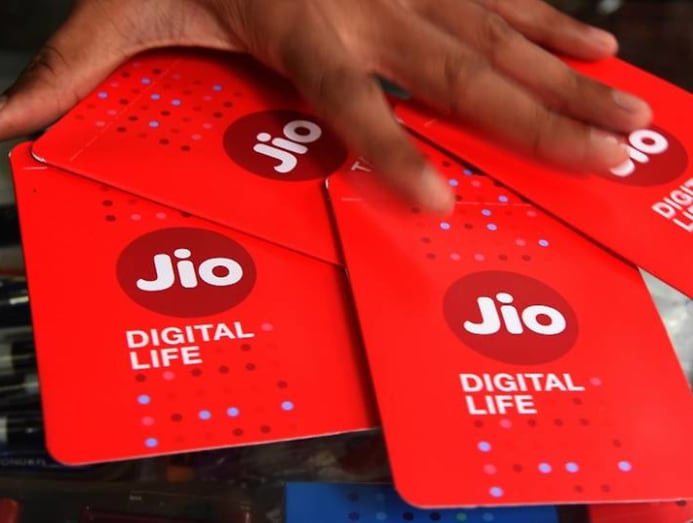
Jio, the mobile operator he launched in 2016, has already muscled aside competitors to go Bharat'southward largest. Ambani hopes it volition become the land's answer to Cathay's Alibaba, a home-grown tech giant in i of the world's fastest-growing internet markets.
For the Facebook executives Fischer and Mohan, joining forces with the "game-changing" Jio was an opportunity that was incommunicable to ignore. And in Apr their courtship culminated with Facebook's US$5.7 billion investment in Jio – its largest foreign bargain to date.
The deal sparked a spree that saw a dozen other strange investors – including Facebook'due south arch-rival Google – write several billion-dollar-plus cheques for stakes in the fast-growing company. "It became a FOMO-kind of situation," said ane person involved.
For Ambani, information technology marked the triumphant noon of a career remaking his father's energy juggernaut into a conglomerate fit for the 21st century. In improver to its dominance in energy and telecoms, Reliance runs India'south largest retail business organization. Ambani and his family unit also own a number of news outlets, oversee a school and a hospital – and run the Mumbai Indians, a successful Indian Premier League cricket team.
"He combines infrequent vision, a huge ambition and outstanding execution," said Harsh Goenka, a Mumbai-based tycoon and friend.
In his business victories and accrual of wealth, Ambani sees a articulate do good for his state, now under Prime number Minister Narendra Modi'south leadership. In 2018, the businessman argued that Jio was "the most powerful driver of change in Bharat today". The message: Saying no to Ambani'southward growth, was akin to saying no to India's.
Nevertheless outside observers point to a near-unparalleled ability to leverage his wealth, political nous and Reliance's scale to build an ecosystem that works in his favour. Ambani is both respected and feared – friends seek his tacit approval before taking on new roles, while rivals try to avert entering into a direct conflict.
One government official suggested Reliance's power evoked that of a nation more than a individual corporation: "Reliance operates as an contained country within a state. Ministers are wary of Mukesh Ambani because he is and so powerful and in that location is a sense that he needs to be handled with intendance."
Ambani'south sprawling business organization interests – and his political clout – mean he is now perceived as a gateway into India'due south blossoming digital and consumer-led economy, one of the last great global growth stories.
Having completed the fundraising for Jio, he is raising billions more from pinnacle investors for his retail business. Merely critics fear that what he is edifice could become a monopoly that will crush competition and, ultimately, hurt Indian consumers, all while concentrating e'er more than power around himself and his family. "He wants to exist Netflix, he wants to exist Alibaba," one former employee said. "He wants to exist everything."
THE EARLY YEARS
In Ambani's spacious, sofa-filled role, located in a nondescript south Mumbai building surrounded by chai and snack stalls, hangs a large portrait of his begetter. If Mukesh is shaping up to be India's most important tycoon of the early 21st century, Dhirubhai Ambani towered over the end of the previous one.
Born in 1932, he was raised in rural poverty in the western Indian state of Gujarat, emigrating to Yemen as a teenager to piece of work at a trading visitor. Upon his render to India in the tardily 1950s, he started trading synthetic yarns, earlier branching into polyester manufacturing, building factories that turned Reliance into an industrial powerhouse. "Dhirubhai was a corking leader," one person shut to the visitor said. Mukesh and those around him "idolise Dhirubhai".
In their early years, Mukesh and his younger brother Anil witnessed their father's struggles to build up his business organisation. Both inherited his outsider's edge, even every bit they went on to enjoy a life of luxury.
Dhirubhai Ambani was the most prominent newcomer to break into a business organisation elite previously controlled by families who had made fortunes during the colonial era. He was known every bit a political fixer, maintaining a legendary influence operation in New Delhi that curried favour with bureaucrats and politicians in lodge to secure much-needed business organisation licences. Critics historically claimed that in those days some officials received benefits, including funding for their children's education. The company and Ambani take e'er contested these allegations.
One person shut to the family acknowledged that Dhirubhai had to do "difficult things" in order to suspension past those elites that maintained a stranglehold at the time. It was a legacy memorialised in the 2007 film Guru, a fictionalised account inspired by his life and distributed past Anil'southward amusement company, which portrays the protagonist as a swashbuckling entrepreneur who pursued growth at all costs and was unafraid to play hardball when shut out by large proper name business owners.
Throughout the decades, the conglomerate's business practices accept continued to concenter scrutiny. In 2017, the Securities and Commutation Lath of Bharat fined Reliance Industries in connexion with a marketplace manipulation case (the company has appealed the order); campaign groups accept also defendant Reliance Industries of having inappropriate links with the government in a Supreme Court instance over a gas exploration deal, something Reliance denies.
Ambani, who rarely speaks to the press, declined to exist interviewed for this article. Reliance declined to requite responses for publication to diverse points put for comment, saying they appeared to be based on "inaccurate" data from sources of "doubtful veracity".
Ambani left Stanford Business School mid-degree in his early twenties to aid run a polyester institute, and rose upward through the company. But Dhirubhai's decease in 2002 prompted a legendary clash between the brothers over how to run the empire.
In a 2005 peace bargain brokered by their mother, the pair divided the conglomerate. Anil, seen equally the more stylish brother and married to a Bollywood star, spun off Reliance's finance, ability and existing telecom businesses and ventured into film production. The insufficiently unassuming Mukesh took the cadre oil products concern.
But the brothers connected to trade barbs and to block each other in a fallout that gripped Indians at dwelling house and abroad. In an barb to a club that emphasises family loyalty and unity, Anil even became embroiled in a defamation allegation against his brother over comments in which Mukesh appeared to propose Anil had overseen Reliance's corporate "intelligence" operations.
Disharmonism OF THE TITANS
Information technology was the launch of Jio that would ultimately requite Mukesh the upper manus in the biting battle with his blood brother. While he had previously helped prepare up a telecommunications business under his father, he lost information technology to Anil under the terms of the 2005 divide.
He, in turn, used his start correct of refusal under those same terms to scupper a deal by Anil'due south Reliance Communications to merge with South Africa'due south MTN, which would have created one of the globe's largest mobile companies. Then, in 2010, Mukesh made a decisive motion that would ultimately quash his sibling's business, securing a spectrum licence for his new operator.
This renewed foray into telecoms puzzled many who questioned why a company that ran one of the world's most successful oil refineries would invest billions in a speculative venture at a time when India'south energy consumption was growing fast.
But western energy industry executives who know Ambani say he has long called time on the historic period of oil. In years past, senior Reliance executives asked industry leaders nigh the possibility of peak global oil demand. "Now the questions tend to be about when [it] will happen, not if," said ane person involved in such discussions.
Free energy remains a key pillar of the Reliance empire just Ambani has sought to dilute his stake and is now pursuing a strategy to become a net zero carbon visitor. Final yr, Reliance said it planned to sell 20 per cent of its refinery business organisation to Saudi Aramco for nearly US$15 billion.
But the deal, slated to be one of India's largest e'er foreign investments, has stalled after the kingdom baulked at the price tag post-obit the abrupt drop in oil prices during the pandemic.
As Ambani'southward focus has shifted towards tech, he has often repeated the cliche that "data is the new oil". Bharat certainly presented one of the globe's most promising markets. Hundreds of millions were buying mobile phones for the first time, though they connected to run on slower 2G and 3G data and were yet also expensive for many.
Jio'due south plan was to leapfrog the incumbent companies by launching 4G services at radically lower prices. One former employee described this as part of a vision to "democratise access to the net". The same source recalled Ambani's keen interest in the project: Having submitted a chunky research certificate late one evening, a copy annotated in Ambani's handwritten scrawl was returned to him the side by side morning time.
When Jio eventually launched in 2016, information technology chop-chop accumulated millions of users by offering its services at rock-lesser prices with extended introductory offers, undercutting its rivals and forcing them to bring down their own prices.
"He wants to exist Netflix, he wants to be Alibaba. He wants to be everything." – a sometime employee
A boom in internet use occurred as millions of working-class and rural Indians could video call relatives, stream cricket matches or play online games for the outset fourth dimension. "It took the combined Indian telecom industry 25 years to build a pan-Bharat 2G network," Ambani said in 2018. To build an advanced 4G network, "Jio took just three years."
But Jio's success has been marred by repeated allegations of bully-boy tactics to crush competitors, including predatory pricing. Critics also merits there has been favourable treatment by the authorities, including Jio existence exonerated by regulators and competition government despite extending introductory price offers by the usual xc-24-hour interval window.
Reliance'southward path was cleared after a 2022 regulatory change allowed it to convert its data licence to transmit voice calls likewise. A draft written report past the state auditor plant that Jio had effectively underpaid by effectually Rs230 billion (Due south$4.25 billion) in securing the unified licence, but the concluding release of the report dismayed Jio'southward critics past finding its underpayment to exist much smaller.
In the view of Prashant Bhushan, a public interest lawyer who has brought multiple cases against the visitor: "[Reliance] were quite smart in investing in the telecom sector. Simply more than that they accept been helped at all stages by the government and now past the courts."
Since then, a moving ridge of telecom companies accept been forced to exit the mobile sector or gone bankrupt. Only two private competitors remain: Vodafone Idea and billionaire Sunil Bharti Mittal'south Airtel. Mittal told the FT concluding year that competing with Reliance was "hard work . . . They want to be dominant". Both companies were dealt a severe blow after a courtroom ruling last year ordered them to pay billions of dollars to the government in historic fees. The younger Jio, withal, was asked to pay only US$2 meg.
In the view of Rahul Khullar, a former chairman of the Telecom Regulatory Dominance of India: "Biased and partisan regulation in favour of Jio has led to the general crunch in the industry." He added: "Jio was bleeding Airtel and Vodafone Thought in the hope that you lot'd have a final-man-standing situation . . . They didn't care because they had deep pockets elsewhere."
Reliance vehemently denies that it has received favourable handling and attributes its success to Ambani's business organization acumen and bold vision.
One of the worst hitting by Jio'southward ascent was Mukesh's brother Anil: It proved a barbarous accident to his shrinking half of the concern empire. RCom was unable to keep up and quit the mobile sector in 2022 before going bankrupt. In 2018, Anil himself said that the telecom sector was becoming an "oligopolistic structure that . . . could eventually become a monopoly".
Mukesh'south fortunes stand in stark contrast to his blood brother. "What [Mukesh] did right, he was the guy who was behind the core businesses. It wasn't Anil," said Sucheta Dalal, a veteran journalist, who has long covered them both.
Last year, Anil'southward mounting debt troubles were and so acute that he was days away from being jailed for contempt of court over a missed US$77 million payment to Swedish group Ericsson. A last-minute bailout from Mukesh was fabricated sweeter when Anil, in a humiliating capitulation following their feud, conveyed his "sincere and heartfelt thanks to my respected elder brother."
A spokesperson for Anil Ambani said the payment was a business transaction, denying it was made in a personal capacity.
Anil is now being pursued past Chinese creditors, who, in May this year, secured a Great britain court order mandating he pay them United states$717 one thousand thousand. The pressure ultimately prompted him, once the sixth richest human in the earth, to merits in court earlier this yr that his cyberspace worth had plummeted to zero.
SYMBOL OF Farthermost INEQUALITY?
Today it is Mukesh who is at number vi on the Forbes list. He and his family live in a 27-storey skyscraper consummate with a helipad, sports facilities and space for hundreds of staff.
The building, named Antilia after the mythical isle, is believed to be the globe'southward nigh expensive home, with a rumoured price tag as high every bit United states$1 billion. It has also become i of the near stiff and emotive symbols of India's already extreme inequality, towering over the slums that house four in 10 Mumbai residents without running water and with toilets shared by hundreds of families.
"There'due south a category of people, me included, who are outraged by the fact that he spent so much money to build a edifice," said one veteran Mumbai businessman, who views it as "an explicit attempt to flaunt his wealth".
In December 2018, the festivities to celebrate Ambani's daughter Isha'south nuptials, rumoured to have cost equally much every bit US$100 miliion, pushed the already elaborate genre of Indian weddings to new extremes. Beyonce gave a performance, guests included Hillary Clinton and Ban Ki-moon, and – in a bizarre plough – Bollywood superstars Shah Rukh Khan and Aishwarya Rai Bachchan were photographed serving food.
Despite this, Ambani and his company push a carefully crafted image of a man of simplicity. Reliance says that Ambani caps his annual salary to Rs150 meg "in order to ready a personal example of moderation in managerial bounty levels". He is religious and regularly performs Hindu rites, shunning meat and booze.
I person close to the company says he has "a artless curiosity", staying up late reading about emerging business trends. He is besides a family human being. "You lot hear stories about the weddings and the choppers and whatnot simply, in person, he doesn't meet as someone who is suffering from megalomania. He is a very simple man," said 1 person who has had business dealings with him.
Ambani's wealth and influence at abode has opened doors away. Last autumn, he travelled to the Middle East, where he was built-in in Yemen in 1957. This time, the setting was an exclusive get-together aboard the megayacht of Saudi Arabia'southward crown Prince Mohammed bin Salman in the Cerise Sea, forth with more than a dozen top concern people including Masayoshi Son of SoftBank. Of the attendees, it was Mukesh that sat next to the crown prince.
He returned to the Gulf presently afterwards for Riyadh's annual investment summit, dubbed Davos in the Desert. While there, he attended a dinner hosted by the heir to the Saudi throne, forth with Narendra Modi, Jared Kushner, Brazil's Jair Bolsonaro and Steve Schwarzman of private equity company Blackstone. Although a private business executive, in some ways Ambani was acting as India'due south main diplomat.
Ambani – who once sent a life-sized elephant made out of silvery to Center Eastern royalty – is a deft political operator. At the Riyadh conference, he showered praise on Prince Mohammed, who was facing international censure over the 2022 murder of dissident announcer Jamal Khashoggi. Ambani told the audition that the kingdom, like India, was "blessed with leadership that is unique in the whole world".
"Y'all hear stories about the weddings and the choppers and whatnot but, in person, he doesn't come up across as someone who is suffering from megalomania. He is a very unproblematic human being." – a business acquaintance
"From State of kuwait to Saudi Arabia, Abu Dhabi to Doha . . . [Ambani] has that trust," said Anshuman Mishra, a onetime broker who is a close confidant of Ambani and advised him on his international dealmaking. "Sovereign wealth funds, the The states tech giants, they will all accept to engage with Reliance at some point. That's the but serious game in town if you lot remember of India."
Mounting tensions between the U.s. and Red china have only increased Ambani's entreatment to American investors looking for culling partners in Asia. India's own souring relationship with China has also worked in Reliance's favour. The land's motility to ban well-nigh 200 Chinese-made apps including TikTok, following deadly border clashes between the ii nations in June, has created a vacuum for moneyed newcomers.
Ambani himself helped to fan economic nationalism. In 2019, he warned about the dangers of "data colonisation" by foreign corporations. Notwithstanding, as the government mulled strict new curbs on foreign tech giants, he partnered with Google and Facebook, who between them command nearly ii-thirds of India'southward digital advert market.
He is too at present said to exist in talks most potential investments in his retail venture with online retail giant Amazon, whose expansion plans in India accept previously been scuppered by unfavourable regulatory processes for foreign companies that have worked in Reliance's involvement. Reliance has dismissed mention of such talks as speculation, and stressed that its partnerships with Google and Facebook would not compromise India's information.
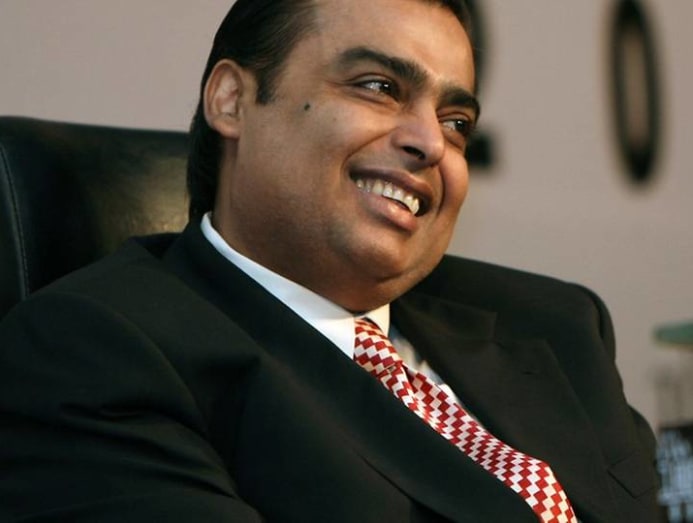
At dwelling house, Ambani has proved skilful at navigating India's irresolute political winds, cultivating ties to multiple political parties. But the tycoon'due south affinity with Narendra Modi has proved more visceral. Both devout Hindus from the country of Gujarat, Ambani shares Modi's sense of beingness an outsider smashing down decades-old power structures, something that Indians likewise accept seized on, delivering 2 landslide election victories for Modi.
Ambani has aggressively used this alignment to advance Jio, which plastered the leader's confront on its adverts and even pre-installed his controversial "NaMo" app on its low-toll JioPhones. In slogans Reliance has touted that, like Modi, it is "defended to Republic of india".
But at that place is growing consternation about the systematic mode Reliance is placing itself at the centre of critical sectors of India'southward burgeoning new economy, raising questions virtually whether Ambani'south ability to overrun contest will ultimately be good for regular Indians in i of the world's fastest-growing consumer markets.
In September, protesting farmers burned Jio cards in a gesture against excess corporate power. Harsimrat Kaur Badal, an outgoing government minister, on television set held up Jio as an instance of the danger of monopolies. "They gave free phones . . . [users] got dependent on it," she said. "The contest was wiped out, [then] Jio jacked upwards their rates."
Reliance at present runs one-third of all brick-and-mortar stores in the land'southward formal retail sector, making it several times larger than its side by side competitor. The recent necktie-up with Facebook and its messaging service WhatsApp, which has 400 million Indian users, gives Reliance unique accomplish amongst consumers.
"It's very difficult to have another major player considering of the intensity of what he does, the magnitude of what he does," ane person who knows Ambani said. "When he enters a field, he enters to be the dominant histrion."
Ambani now has to show he can make good on his bold claims. While he has touted Jio'southward enormous user footprint to investors, regulatory data for June shows that a fifth of Reliance's 398 million reported client base is inactive. And, though at an early phase, many of Jio's forays beyond telecom such equally its payments or chat apps have had limited success so far.
All the same competitors fear Reliance'southward ability to draw in billions in foreign investment, all while undercutting rivals, will leave India with fewer choices. "The trouble for us is that they'll scare investors," said one venture backer. "Just whether they'll create the best products and services, it's hard to say."
"Reliance operates as an contained land within a land. Ministers are wary of Mukesh Ambani because he is so powerful and there is a sense that he needs to exist handled with care." – an Indian authorities official
Family unit TIES
In a Netflix series shadowing the Mumbai Indians IPL team in 2018, Ambani's eldest son Akash stands on a cricket field with the top of his white shirt casually unbuttoned. Akash, whose responsibilities in the family unit business include helping lead the team, banters with the camera while tiptop cricketers railroad train alongside him. "We desire to win desperately this year, prove everyone wrong," he said.
The squad went on to have a mediocre flavour just the younger Ambani's chutzpah fits with his father's winner-takes-all business concern mentality. The tycoon, who ofttimes turns to his wife for advice forth with a tight-knit grouping of top executives, is slowly shifting his three children – Akash, his twin sister Isha and younger brother Anant – into ever more prominent positions within the empire in what many believe is the early on stage of a succession plan.
Akash and Isha had a seat at the table during recent deal negotiations, including the one with Facebook. "It was the way I'd expect a grooming exercise to pan out. They were learning the ropes," one person involved said. "They were probably being blooded . . . so that i day they go on to run the company."
Indian business families, not least the Ambanis, have faced infamous succession bug; generations that grew upwards with silver spoons are treated with item scepticism. People close to the tycoon say he is adamant to avoid the messy familial spats that accept marred his own career, pointing to the apparent symmetry of splitting his empire into three units centred on energy, retail and digital services.
By helping to transform Reliance'south businesses into globally run ventures, including giving Jio board seats to experienced investors Facebook and Google, they say that he wants to ensure his children are shielded from perilous domestic politics. "Mukesh now wants to have less engagement with policymakers," ane adviser said. "He doesn't desire his kids to have to deal with it."
Merely Ambani likewise doesn't desire to retire before he'due south succeeded in turning Reliance into i of the globe's most valuable companies. In the words of ane close to him, Ambani's plan is to create "not just a telecom player, just a serious tech thespian with a global footprint."
Benjamin Parkin is the FT's Mumbai contributor. Anjli Raval is the FT'southward senior energy correspondent. Additional reporting past Amy Kazmin
By Benjamin Parkin and Anjli Raval © 2022 The Financial Times

Contempo Searches
Trending Topics
mandevilleshostres.blogspot.com
Source: https://cnalifestyle.channelnewsasia.com/people/mukesh-ambani-reliance-industries-247201
0 Response to "India’s Mukesh Ambani: Bad boy billionaire or ‘a simple man’?"
Post a Comment